
Double-click to edit...
You would not expect to find a farm in the urban cityscape of Copenhagen. It is perhaps the last place you would search for world-class produce. Yet, inside a non-descript building on Frederiksborgsvej, a small group of entrepreneurs have created a small urban farm dedicated to one specific goal. Creating the most flavorful organic and sustainable mushrooms the Copenhagen dining scene has ever seen.
Funga Farm is the brainchild of American-born Thomas Kyle Cometta. Or Kyle, as his friends would say. Kyle has, through passion and geeky approaches, revolutionized mushroom farming with urbanely farmed quality products rooted in locality and sustainability. And he vividly dreams of expanding his dream into a co-op driven business model far removed from the capitalist-inspired business ideals you would perhaps assume an American to hold.
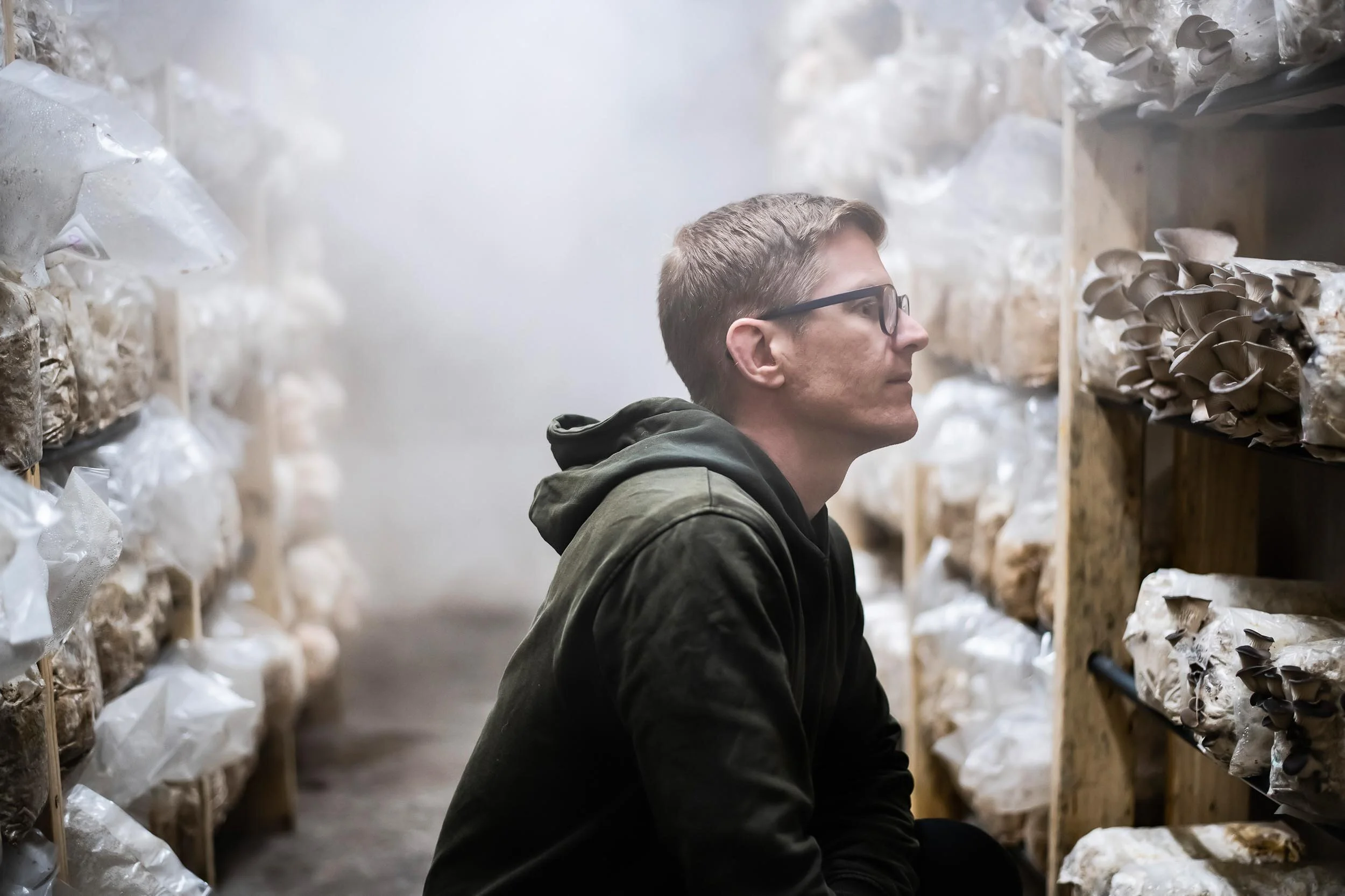
“I moved to Denmark from California about seven years ago because I was really missing nature,” he begins to explain, already overflowing with enthusiasm and passion. “My Danish family introduced me to the woods. They took me on my first mushroom hunt, and it changed me completely. First and foremost, I was blown away by how much gourmet food was just lying on the forest floor. Then I was blown away by the lack of variety in mushrooms that people here actually ate.”
“It ignited in me a passion for mushrooms, their multitude of varieties and everything around them,” he continues. “I started researching subjects such as soil, microbiology and growth mediums. Even the obvious health benefits that are still so understated.”
Funga farm is A sustainable and solidarity-driven business model
For the passionate and knowledge-seeking Californian, research quickly turned into experiments in growing mushrooms. His first attempts took place at the family’s summer cottage and the young man had quickly found his calling. “I found out I really enjoyed working with living organisms and growing something special. And obviously, the buzzing Copenhagen food scene was ready for a quality product like this.”
Funga Farm was founded March of 2019 with the goal producing superior quality mushrooms for local businesses on a sustainable and solidarity-driven business model. “We are three people. I am, for now, the sole owner, but I never wanted to do it alone. I never dreamt of being a CEO with total ownership. I want to work with people and raise them to take ownership, so we can produce the best possible product. Together.”
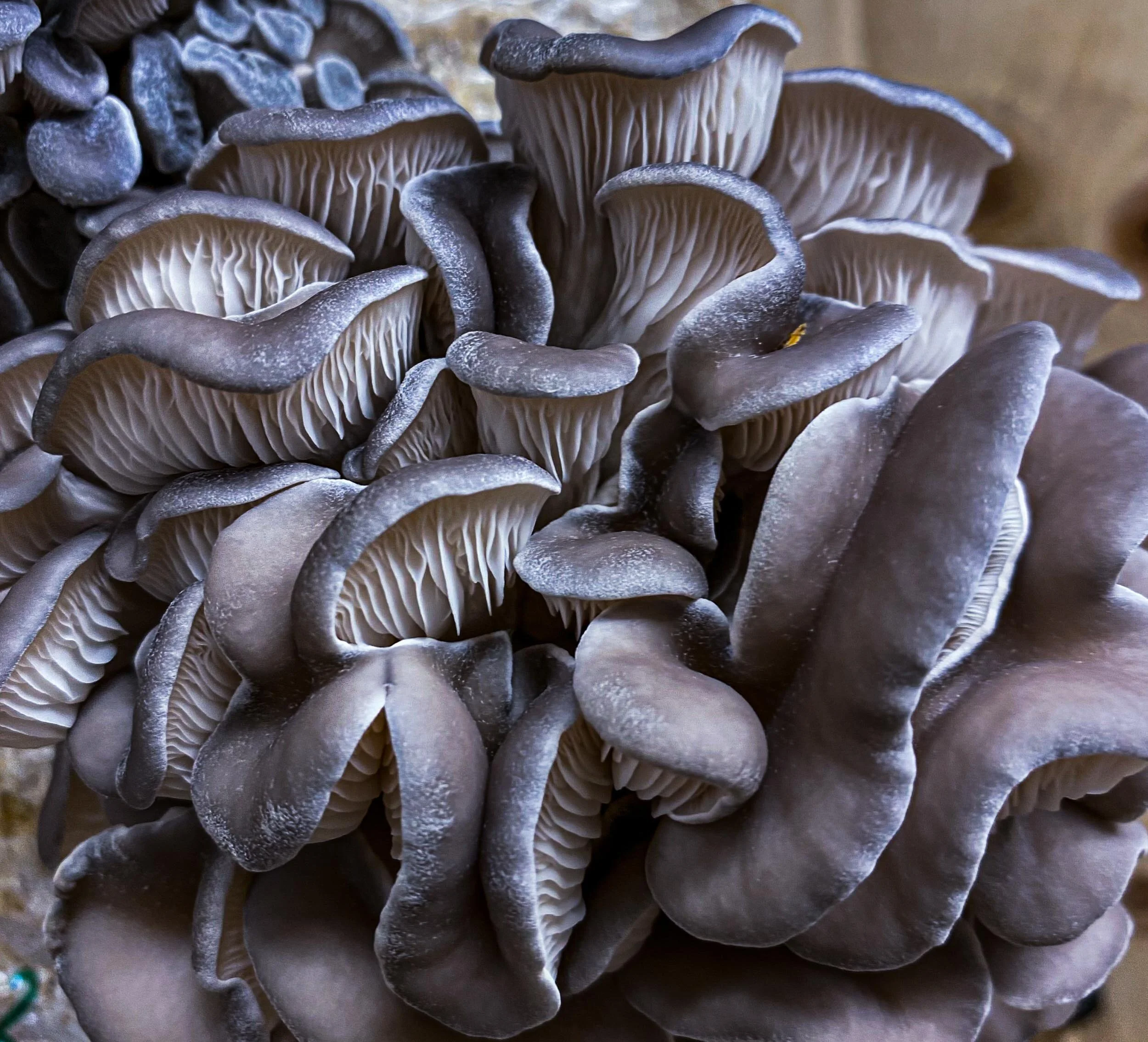
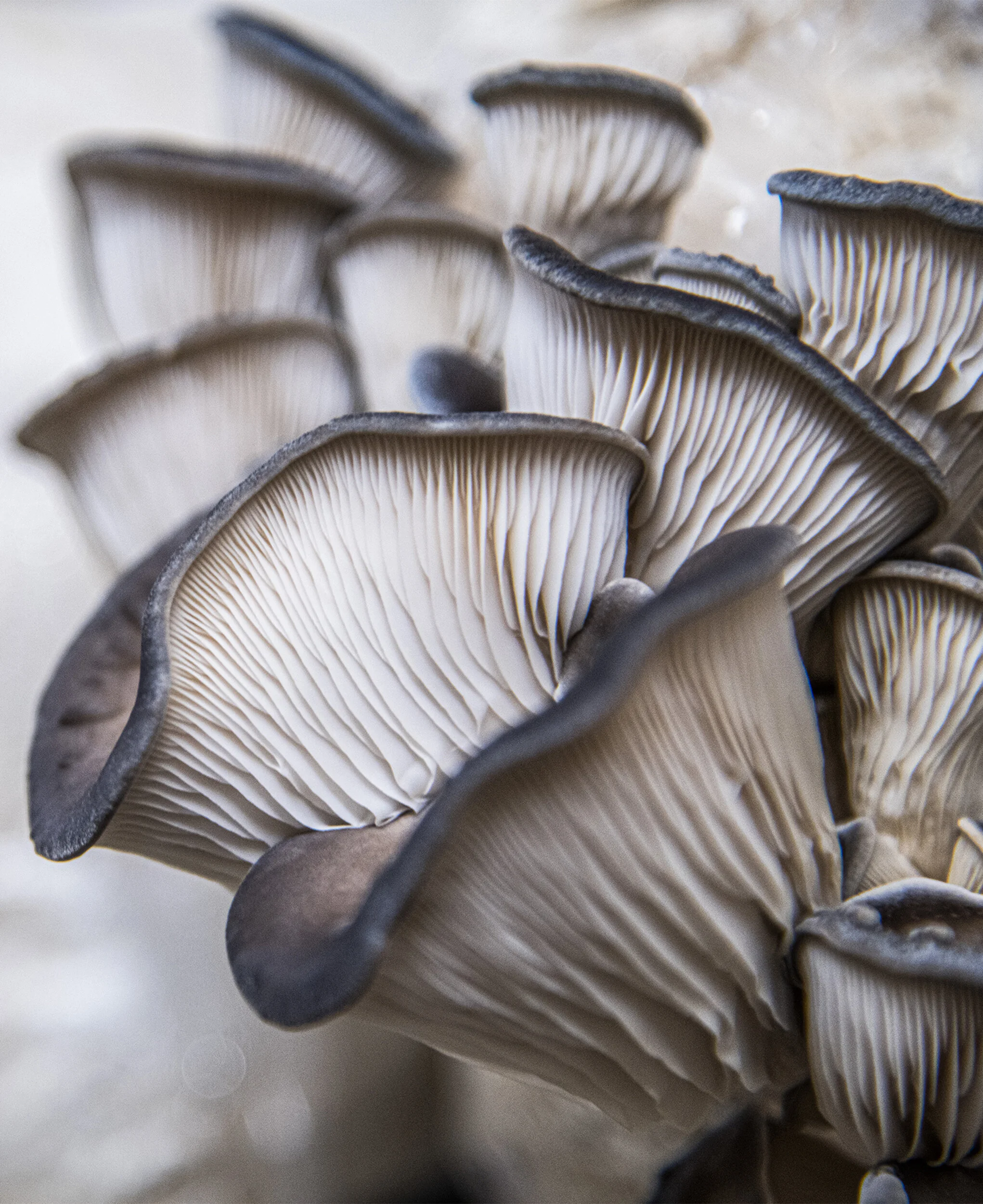
The product lineup currently includes 6 gorgeous varieties ranging from oyster mushrooms over the beautiful and beneficial Lion’s Mane to enoki and others. All of them carefully selected and grown to offer the best possible mushroom experience in terms of flavor and texture. One that is arguably lightyears ahead of the competition owing simply to the amount of thought, dedication and attention to detail poured into the process.
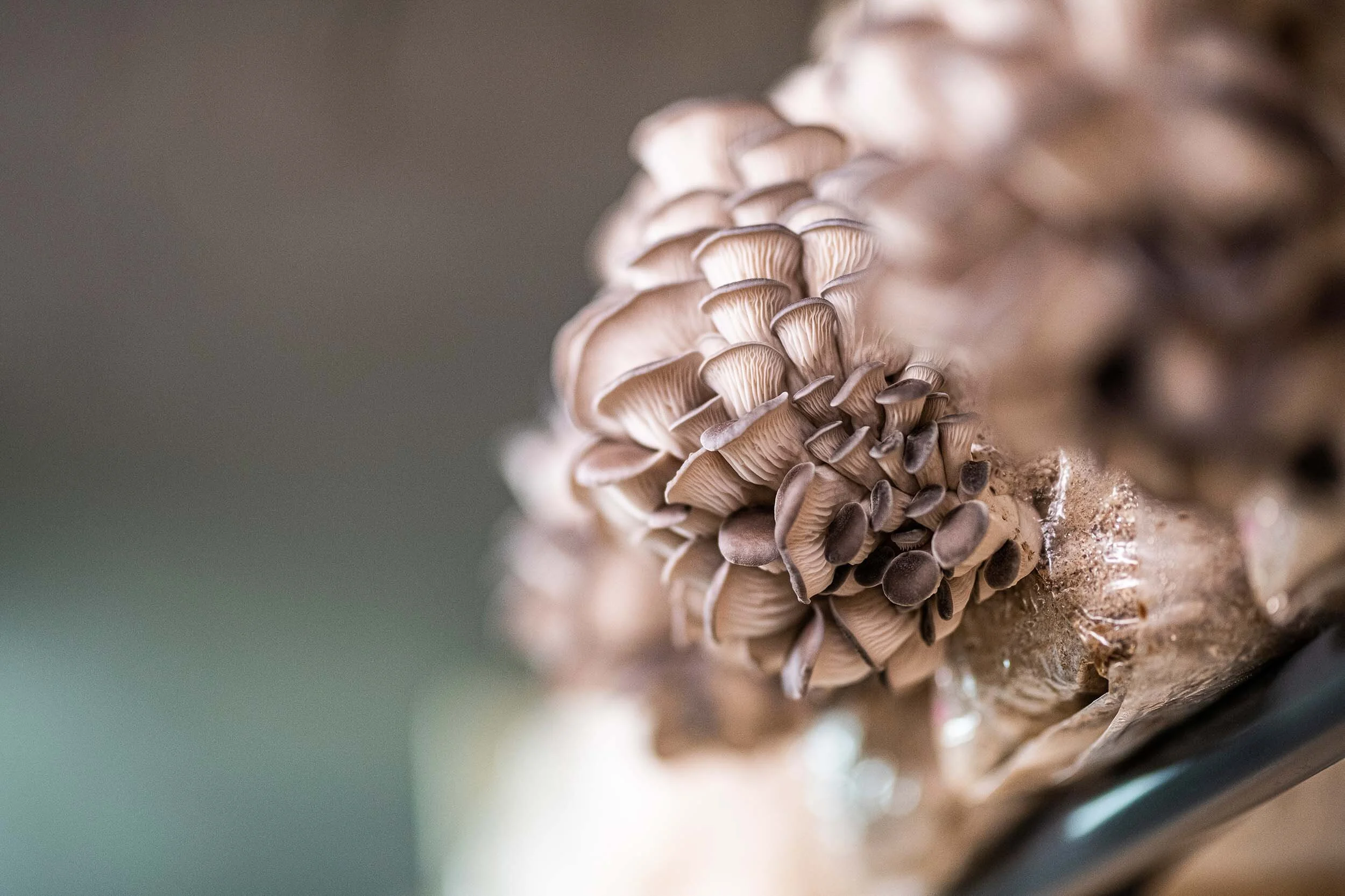
“The same mushroom varieties,” Kyle admits, “you can get organically from Poland, but of course the quality is much, much lower and the sustainability is in question. We try to produce a superior product from local ingredients. All our ingredients come from Denmark and are obviously all organic. We grow our products organically on wood chips sourced from local forests, and we do so from mycelium, mushroom seeds, that we have cloned ourselves from local wild strains. We try to keep everything as local and sustainable as possible. We grow our product as close as possible to where it is needed. So not only do ingredients and materials not travel very far to get to us, but neither does the final product. We pick the mushrooms when needed and deliver them by bike in Copenhagen whenever possible.”
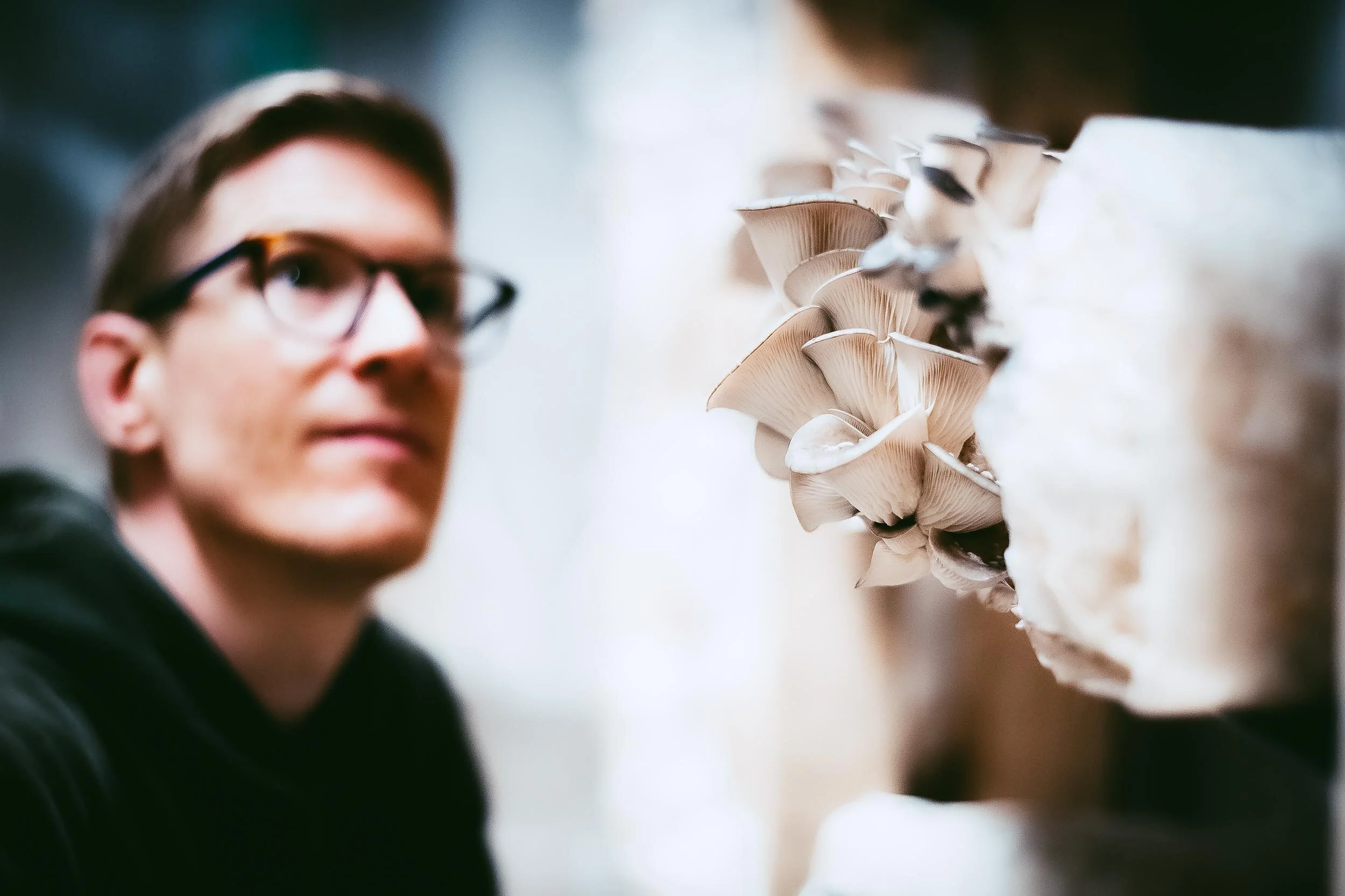
“It was a much tougher way to start a business,” he admits, “but it gives us so much more control over the process, and the quality and sustainability of our mushrooms.” And, obviously, quality and sustainability in every part of the process is of the utmost importance to Kyle and his likeminded partners who, despite the urban placement of their farm strive to create a product as close to what nature intended as at all possible.
“When you observe mushrooms growing in nature, they grow on fallen trees. Many other sustainable producers grow them on coffee grounds, paper, or another degradable medium. It is sustainable, of course, but also cheaper, faster, and easier. We grow ours on wood chips - as closely as possible to how they would grow in nature. Mushrooms will grow on and break down just about anything, but you won’t get the same amount of natural flavor unless you grow them the way nature intended.”
“For our first experiment,” he states energetically to prove his point, “we got mycelium from a local producer growing on coffee grounds. We grew them on wood chips at the summer house and the results blew us away. You had the exact same genetics but a remarkably different result. A remarkably better flavor. And that blew my mind.”
Taming the wild mushroom strains in search of quality
Finding a growth medium was the first part of the process, but the breaking point came in finding what to grow and how to properly grow it, as Kyle passionately explains: “Most mushroom growers get their mycelium from a single producer in Belgium who supplies most of Europe. They promise it has superior genetics, but it is still a monoculture and brings very similar results. We took a wild strain of oyster mushroom that we cloned and grew alongside the commercial strain form Belgium. By far, our wild strain outperformed the commercial strain in every aspect including flavor. So, what we have been doing since is to forage local, wild strains, clone them and grow them basically from spores. Not only do we have our hands in every step of the process, we are also able to produce mushroom variants that other growers cannot. And it is an entirely natural and local process. In terms of sustainability, we can just dump our waste in the wood – it is, after all, organic, local and it adds to the biodiversity.”
His heartfelt words make it clearer than daylight on a summer’s day. To Kyle, and to his partners at Funga Farm, sustainability is about much more than just the product. It is in every part of the process. But even knowing so, things take a pleasantly unexpected turn when you are confronted with just how broadly Kyle thinks sustainability into everyday life and his business model.
“We are, for now, three guys working full time with me in charge, but we are actively working to turn it into a working co-operative,” he repeats once again.
“I have been working 7 days a week, 8-10 hours a day, burning myself out. It is simply not sustainable. Sustainability, to me, is also about bringing people in who are like-minded. People you can elevate to take care of all tasks at hand. Normally, in a capitalist venture, that would not make sense. But I am working to elevate people working with me to know as much as I do, take ownership and help create an even better product.”
“I want to show them the way that I think things should be done. I want them to try it out for a while. And then I want them to come back to me with their feedback and experiences. We talk things through and make changes accordingly. That way, we constantly improve upon our production methods and our statues in terms of sustainability.”
I have been working 7 days a week, 8-10 hours a day, burning myself out. It is simply not sustainable. Sustainability, to me, is also about bringing people in who are like-minded.
And it is perhaps this sharing of knowledge, plans and ideas that have helped Funga Farm struggle on through the Covid-19 pandemic, the arguably darkest period for small-scale producers and their core customers alike.
“We are a small, local business,” Kyle first explained in this late 2020 interview with Yeswefood.com. “We offer a superior quality product,” he continues, “and therefore we are a bit more expensive than our competitors. For now, restaurants are where the money is. Dedicated chefs care about our product being a step above the others. And they share our ideals about locality and sustainability.”
Offering diversity to the Danish food scape in a time of crisis
Fast forward a few months into the ever-changing world of the pandemic, and these plans have now radically changed. Restaurants have been put under lockdown, twice, or closed and like so many others in the industry, Funga Farm are adapting to new business models in record time. The clientele now also includes quality-conscious consumers who want to try firsthand at home, the produce they adored at local restaurants. The object of the exercise seems to be to not only stay afloat and continue a planned expansion. For Funga Farm, growing mushrooms seems as much about creating a better world as it does about being profitable in doing what you love.
“We want to up our production and we want more space. We are producing 100 kilos per week and we would love to produce a thousand. But we want to make sure we do it right and that we do not sacrifice our ethics regarding sustainability and locality along the way. We are doing this for Denmark, after all,” he sums up his thoughts about the present and future before clarifying a bit: “We want to take what we are doing and spread it. We would love for there to be satellite farms and for their production to be equally local but more diverse.”
“Imagine if there were a Covid-19 mutation that traveled on food,” he muses thoughtfully in a bit of a nightmare scenario for conventional consumers. “If borders had to be closed to imports, Denmark would be pretty much left with potatoes and cabbage – and that would just be sad!”
It is a scenario we all hope never to face, but should it ever happen, at least now we can add world-class organic mushrooms to the list of produce grown locally. And while we wait for Covid-19 to hopefully soon be a thing of the past, let us at the same time hope that the dream of locally attached satellite farms remains intact. Denmark is indeed much more than a potato and cabbage-producing country today, thanks in large parts to people like Kyle and his peers who selflessly slave to bring quality, afterthought, environmental respect, and locality back into modern day food production.
The produce and mindset are here. The real challenge now lies in making the produce and mindset accessible to the general population.
